
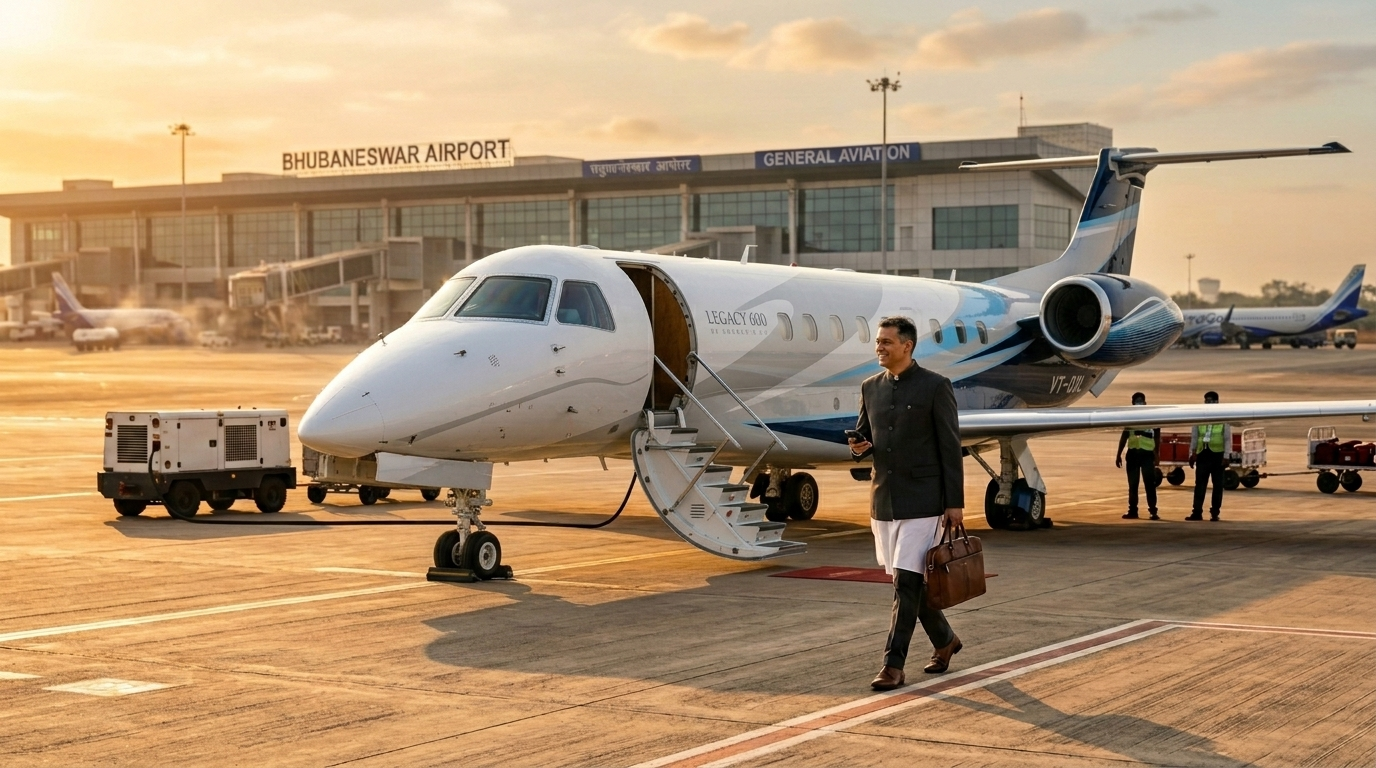
By Capt. Sandeep Mishra | Founder, Aerokalinga Aviation Pvt. Ltd. (Air Kalinga)
For decades, business aviation India carried a single association: wealth display.
That association is now obsolete and the data confirms it.
Business jet registrations in India rose 35% in 2024 alone, driven not by status-seeking but by a corporate culture that is finally doing the maths on executive time. India now has over 550 private aircraft, including jets, turboprops, and helicopters, making it South Asia’s largest general aviation market.
The shift in business aviation in India is structural, not cyclical. The India business jet market reached USD 650.5 million in 2024 and is projected to reach USD 1,139.9 million by 2033 at a CAGR of 6.43%. Corporate India’s top leadership across steel, pharmaceuticals, technology, energy, and financial services is not switching to Indian business aviation because it looks impressive. They are switching because it delivers measurable competitive advantages that commercial aviation structurally cannot.
This article breaks down the nine strategic reasons why India’s most ambitious business leaders are making the switch and why private aviation for business leaders in India is no longer a luxury conversation but a productivity and competitive strategy one.
What Is Driving Business Aviation India’s Rapid Growth in 2026?
Before the nine advantages, the market context is worth understanding precisely.
Business aviation India has seen its private jet fleet grow 25% since 2019, reflecting rising corporate demand and wealth expansion with executives increasingly needing point-to-point travel between tier-two cities where commercial airlines offer limited service.
Business aviation accounts for roughly 8–10% of India’s aviation sector, valued at USD 14.78 billion in 2025. The DGCA currently oversees approximately 160 active Non-Scheduled Operator Permits (NSOPs), the regulatory framework under which all commercial charter flying in India is conducted.
Corporate charter requests have tripled compared to the previous year, driven by demand for flexible scheduling and multi-leg mission planning.
What is shifting in business aviation in India is not just volume; it is the profile of the buyer. Five years ago, the typical private jet user in India was an ultra-high-net-worth individual or a Bollywood personality. In 2026, the profile has expanded to include mid-sized manufacturing companies moving their MD between factory sites, pharmaceutical companies coordinating clinical and regulatory teams across cities, and mining and energy companies accessing sites that commercial aviation does not serve.
The business case has become undeniable, and the nine advantages below explain exactly why.
Advantage 1: Business Aviation India Converts Dead Travel Time Into Productive Hours
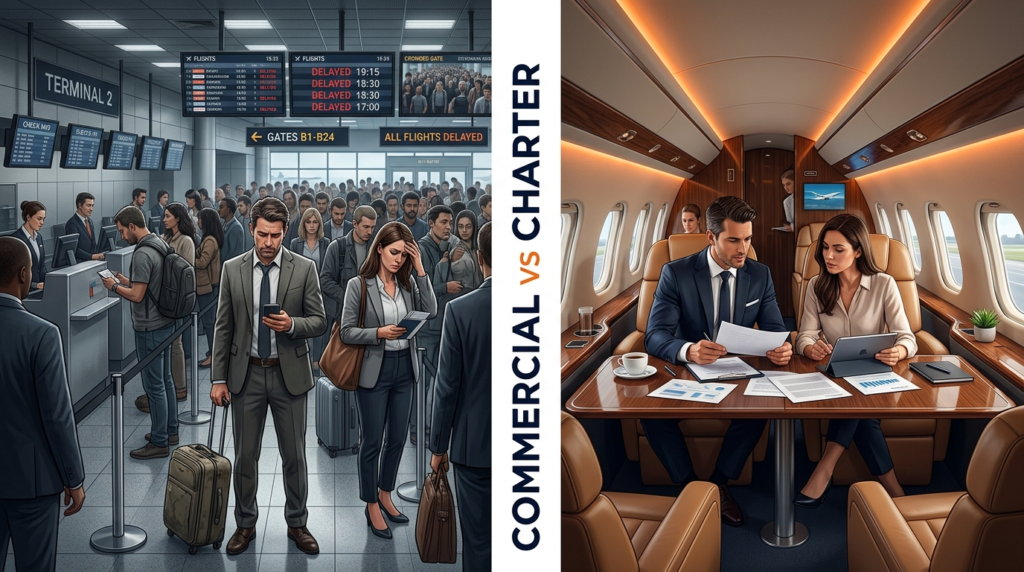
Executives save 3–5 hours per trip compared with commercial flying, when you account for airport arrival buffers, check-in queues, boarding, in-flight restrictions on confidential discussion, baggage reclaim, and ground transfer at the destination.
For a CEO travelling twice a week across Indian cities, that is 300–500 hours per year. At the leadership level, those hours have computable value in decisions deferred, conversations not had, and opportunities missed while waiting in a commercial terminal.
Business aviation in India’s private charter context eliminates the majority of that overhead. Departure from a dedicated General Aviation Terminal (GAT), 15-minute arrival windows, direct boarding, immediate takeoff upon receiving ATC clearance, and arrival at the destination FBO closest to the actual meeting venue. The entire process is calibrated around the executive’s schedule, not the airline’s.
The cabin environment in business aviation India becomes a secure mobile office, enabling executives to hold confidential meetings or prepare sensitive presentations without distraction.
For a mid-size company with four directors travelling to three cities in one day, a common requirement in industrial India, private aviation is not just faster. It is the only option that makes the itinerary possible.
Advantage 2: Corporate Charter Flights India Unlock Tier-2 and Tier-3 Connectivity
This is the advantage that most discussions of private aviation overlook and the one that matters most for industrial India.
Executives increasingly need point-to-point travel between tier-two cities where commercial airlines offer limited service. This is where business aviation in India’s value becomes immediately obvious.
India’s commercial airline network is built around trunk routes between Delhi, Mumbai, Bengaluru, Chennai, and Kolkata. It does not efficiently serve the steel towns of Jharkhand, the mining districts of Odisha, the pharmaceutical hubs of Andhra Pradesh’s interior, or the agricultural processing clusters of central India.
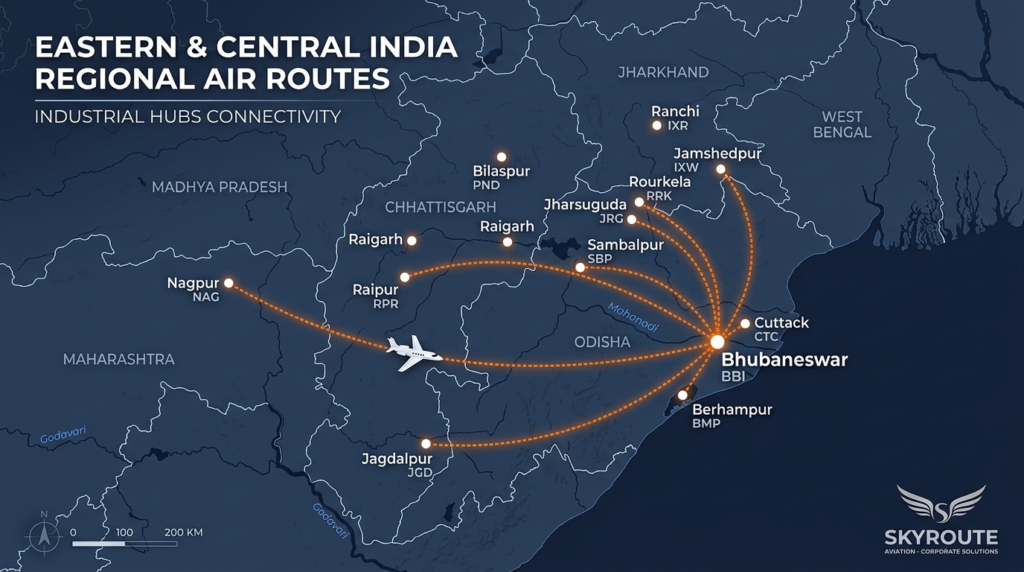
Corporate charter flights in India fill this gap precisely. An executive in Bhubaneswar can reach Jharsuguda, Rourkela, Sambalpur, Raipur, and Nagpur in a single day using a turboprop or light jet a multi-city itinerary that would take three days using commercial connections, if it were even possible without overnight halts.
This is not an edge-case benefit. For any company with operations distributed across India’s interior, executive mobility in India via private charter is the difference between leadership that visits the business and leadership that manages it remotely. The productivity and culture implications of that distinction are significant.
Air Kalinga’s charter services across Odisha are specifically designed for this need, connecting Bhubaneswar to the state’s industrial corridor with same-day return itineraries.
Advantage 3: Business Jet Charter India Offers Unmatched Schedule Control
The most senior executives in India operate on calendars where a two-hour delay in the morning cascades into a collapsed day.
VistaJet reported that corporate charter requests surged threefold in the first half of 2025, driven largely by demand for flexible scheduling and multi-leg mission planning. For executives managing global teams, the ability to adapt travel at short notice is not just convenient, it is essential. This is why Indian business aviation increasingly serves this specific need.
Business jet charter in India means the aircraft departs when you are ready. A board meeting that runs over by 45 minutes does not result in a missed last flight. A deal that reaches the signing stage at 7 PM does not strand your leadership team in a hotel for the night. Last-minute regulatory meetings, investor calls that materialise on short notice, site visits triggered by operational incidents, all of these are manageable with a charter aircraft that moves on your timeline.
For corporate secretariats coordinating the schedules of multiple CXOs, the administrative value of this flexibility is computable in avoided rescheduling, cancelled hotel bookings, and the executive attention spent managing logistics rather than strategy.
Advantage 4: Executive Mobility India Means Total Confidentiality
India’s corporate landscape increasingly involves conversations that cannot happen in a commercial cabin.
Pre-IPO deliberations. M&A discussions between parties that cannot be seen together in public. Board-level restructuring conversations. Negotiations with international investors. Sensitive HR decisions at the most senior level.
Business aviation India provides what commercial aviation structurally cannot: a sealed, private environment where the cabin itself is the meeting room.
Executive mobility in India via private charter means that six board members can brief their legal counsel, review deal documents, and reach a consensus position before landing at the destination, arriving as a unified team rather than individual travellers who need to reconvene before the meeting.
This confidentiality advantage is increasingly relevant as Indian corporates operate in environments where information sensitivity is commercially critical. No conversation is overheard. No screen is visible to a neighbouring passenger. No document is photographed.
Advantage 5: Private Aviation for Business Leaders Accelerates Deal Velocity
Time is not just money in a philosophical sense. In corporate India, speed to decision is increasingly a competitive differentiator.
Private aviation for business leaders compresses deal timelines in two specific ways: it enables leadership to be physically present at critical moments, and it allows multi-city decision-making trips that would take a week by commercial aviation to be completed in a single day.
A private equity firm evaluating three manufacturing targets in Pune, Ahmedabad, and Coimbatore can complete site visits in two days rather than a week. A pharmaceutical company negotiating a distribution partnership across South India can have its CEO present at every critical meeting rather than joining remotely. A real estate developer closing a land deal in a tier-2 city can fly in, sign, and be back in Mumbai before the evening.
The ability to conduct meetings and negotiations during flight offers competitive advantages that are increasingly valued by India’s corporate leadership.
The companies that understand this and build private aviation into their executive mobility strategy, rather than treating it as an occasional indulgence make faster decisions, close more deals, and move on opportunities while competitors are still checking flight schedules.
Advantage 6: Business Aviation India Enhances Leadership Presence at Multiple Locations
India’s fastest-growing companies are characterised by distributed operations. A manufacturing conglomerate may have plants in five states. A logistics company may have distribution hubs in fifteen cities. A financial services firm may have regional offices in every major city with relationship teams in a dozen more.
Business aviation in India allows the senior leadership of these companies to be physically present across their entire footprint in a way that commercial aviation cannot support.
Presence matters in Indian business culture. A visit from the chairman or managing director to a plant or regional office has motivational, cultural, and operational impact that a video call cannot replicate. Site teams perform differently when they know leadership can and does appear without days of advance notice.
Corporations across Mumbai, Delhi, and Bangalore are increasingly turning to business aviation to bypass congested commercial networks but the companies gaining the most advantage are those in India’s industrial interior who use it to maintain leadership presence across geographies that commercial aviation does not connect.
Advantage 7: Corporate Charter Flights India Support Critical Medical Response
This is the advantage that most businesses do not consider until they need it and by then, the decision-making window has closed.
Large corporates with workforces in remote or semi-urban locations face a genuine medical emergency risk that road infrastructure cannot adequately address. Industrial accidents, cardiac events, strokes, and obstetric emergencies at factory or site locations require rapid access to tertiary care that can be an hour’s flight away but five hours by road.
Corporate charter flights in India specifically, operators with medevac-configured aircraft and trained medical crew provide employers with a critical duty-of-care capability that is increasingly becoming part of responsible workforce management.
For Odisha’s industrial corridor Vedanta, NALCO, Coal India, Tata Steel Odisha Air Kalinga’s 24/7 air ambulance service gives large employers a medically equipped response that is activated in hours, not days. For a full breakdown of what this means in the Odisha context, see our air ambulance service Odisha guide.
Advantage 8: Business Aviation India Reduces the True Cost of Executive Travel
The conversation about private aviation costs in India almost always starts and ends with the headline charter price. It should start with the full-cost comparison.
A commercial business class ticket for four executives from Bhubaneswar to Delhi costs ₹1.4–3.2 lakh in total fares. Add 90 minutes of pre-departure time each way, post-landing transfer, the impossibility of a confidential discussion mid-air, and the scheduling inflexibility that may require an additional day of travel, and the true cost, in executive time and opportunity, is substantially higher.
A charter for the same four executives on the same route costs approximately ₹10–12 lakh spread across four passengers, that is ₹2.5–3.0 lakh per person, roughly 2–4x the commercial fare. But it delivers a 15-minute departure, full cabin confidentiality, a working meeting during the flight, and same-day return capability.
Rising corporate focus on time management is enhancing the preference for business aviation India, with private and customised services providing convenience and privacy for top executives.
For companies where the fully-loaded cost of a senior executive hour exceeds ₹25,000–50,000, the economics of business aviation in India are not a luxury calculation. They are a resource allocation decision. For a full breakdown of charter pricing in India, see our private jet charter cost India guide.
Advantage 9: Business Aviation India Is a Talent and Culture Signal
In India’s hypercompetitive market for senior talent, the signals that companies send about how they treat their leadership matter.
Access to business aviation in India for executive travel, whether for safety, convenience, or time-efficiency, signals that the company values its senior team’s time and well-being enough to invest appropriately in their mobility. For leadership candidates evaluating two comparable offers, the availability of private aviation for frequent travellers is a materially differentiating factor.
A 2025 Wall Street Journal report found that private aviation has surpassed luxury yachts and high-end property as the top status symbol of modern wealth, largely because of its utility and exclusivity combined.
But in the corporate context, the signal is less about status and more about seriousness. Companies that invest in executive mobility infrastructure are signalling that they expect their leadership to be present, productive, and fully operational and that they are prepared to invest in the tools that make that possible.
The India Business Aviation Market: Key Numbers for 2026
For CFOs and strategy teams evaluating business aviation India as an investment, these are the reference figures:
- India business jet market: USD 650.5 million in 2024, forecast USD 1,139.9 million by 2033 (CAGR 6.43%)
- Business jet registrations in India rose 35% in 2024
- Over 550 private aircraft in India South Asia’s largest general aviation fleet
- Honeywell’s 2025 Global Business Aviation Outlook projects 8,500 new business jet deliveries worth USD 283 billion over the next decade, the highest in the report’s 34-year history
- India Aviation market grows from USD 14.78 billion in 2025 to USD 16.53 billion in 2026, reaching USD 28.96 billion by 2031 at 11.86% CAGR
- Approximately 160 active NSOPs currently govern India’s commercial charter sector
These numbers confirm that business aviation in India is not a niche it is an emerging strategic infrastructure for corporate India’s next growth phase.
Frequently Asked Questions: Business Aviation India
What is driving the growth of business aviation in India in 2026? Business Aviation India’s growth is driven by three converging forces: the rise of corporate India’s distributed operations requiring executive mobility across tier-2 and tier-3 geographies; the expansion of India’s ultra-high-net-worth population; and the increasing recognition that private aviation is a productivity investment, not a luxury expenditure. Business jet registrations grew 35% in India in 2024 alone.
How does business aviation in India differ from commercial air travel for executives? Business aviation in India offers schedule control, cabin confidentiality, tier-2 city access, 15-minute departure windows, and productive travel time. Commercial aviation offers none of these at the executive level. The key difference is not comfort it is operational flexibility and time efficiency.
What types of companies use corporate charter flights India most frequently? The highest users of corporate charter flights in India are companies in industrial sectors, such as steel, mining, pharmaceuticals, and energy, with distributed operations across geographies that commercial airlines underserve. Financial services firms, private equity funds, and real estate developers are the next largest user segment.
Is business jet charter India regulated by the government? Yes. All commercial charter operations in India including business jet charter in India, are regulated by the DGCA under Non-Scheduled Operator Permit (NSOP) regulations. Always verify your operator holds a valid NSOP before booking. Visit dgca.gov.in{:rel=”nofollow”} to verify.
What is the typical cost of executive travel India via private jet charter? Executive travel in India via private charter ranges from approximately ₹1.2 lakh per hour for a turboprop to ₹9+ lakh per hour for a heavy jet, plus 18% GST on domestic sectors. For a detailed breakdown, see our private jet charter cost India guide.
Can private aviation India be used for medical emergencies? Yes. DGCA-approved operators with medevac certification such as Air Kalinga, provide 24/7 air ambulance services with ICU-configured aircraft and trained medical crew. This is increasingly being integrated into large employer duty-of-care programmes across India’s industrial sector.
How do I choose the right operator for business aviation in India? Verify DGCA NSOP certification. Confirm the operator owns or formally leases the aircraft; do not rely on brokers who source informally. Request a fully itemised written quote. Check track record and client references. A professional operator will answer all these questions transparently before any payment is requested. For a step-by-step guide, see our article on how to book a private jet in India.
The Bottom Line: Business Aviation India Is a Strategic Decision, Not a Status One
The nine advantages in this article share a common thread: they are all about output, not optics.
Business aviation India accelerates decisions, expands geographic reach, protects confidentiality, saves leadership time, supports workforce welfare, and signals organisational seriousness. These are strategic returns measurable in deals closed, hours recovered, talent retained, and operations managed more closely.
As India becomes wealthier, business aviation in India is becoming an essential but still misunderstood layer of connectivity that corporate leaders can no longer ignore.
The understanding is shifting, however. India’s most forward-thinking companies have already moved. They have replaced the question “is it worth it?” with “which operator, which aircraft, and which routes deliver the best return?”
If your organisation is still asking the first question, this article is your answer.
Air Kalinga provides DGCA-approved business aviation services from Bhubaneswar, Odisha executive charter, corporate mobility, medevac, and multi-city itinerary planning across eastern India and beyond.
Request Your Corporate Charter Quote →
Capt. Sandeep Mishra is a commercial aviation professional with over 22 years of operational experience. Founder and Managing Director of Aerokalinga Aviation Pvt. Ltd. (Air Kalinga), a DGCA-approved non-scheduled charter operator based in Bhubaneswar, Odisha. He is also the founder of Aeromasterclass (DGCA-approved pilot training academy) and Blackstar Aerospace.
Aviation Services & Planning
Air Kalinga offers bespoke aviation solutions tailored around efficiency, safety, and luxury. Learn more about our private aviation services, explore our elite private jet and turboprop aircraft fleet, or contact our concierge team to schedule your flight.
Related Journal Reading: Air Ambulance Cost India: Honest 2026 Price Breakdown Every Family Must Understand